
Instructor Spotlight: Sherry Antonini
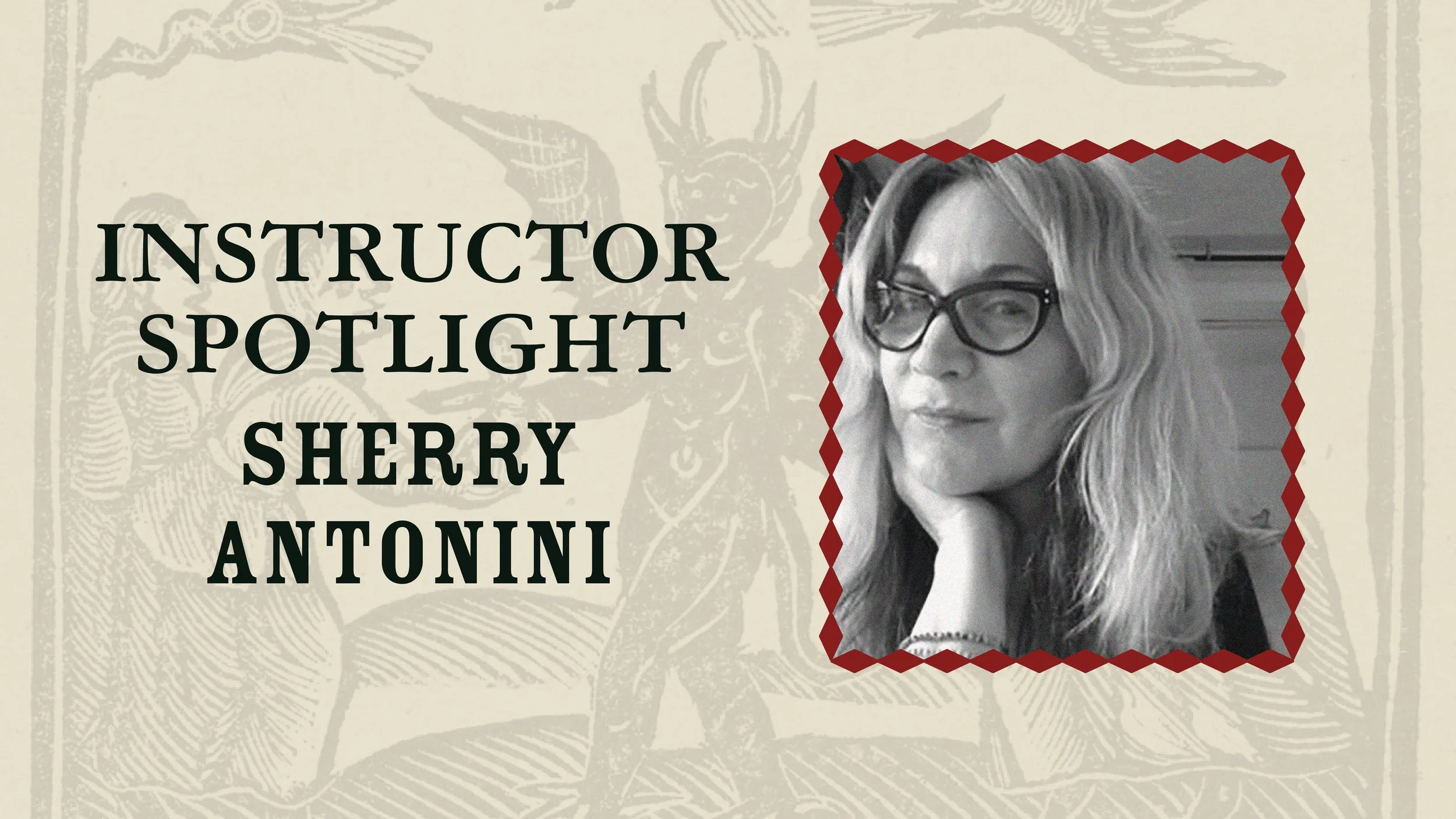
Sherry Antonini teaches Writing from Your Witch Side, Saturday, October 17, 1:00-4:00PM.
Tell us about your experience and key highlights of your work as it relates to the workshop you will be teaching for Artists Book House (ABH).
I have been teaching multigenre and multidisciplinary writing workshops for more than twenty years. In recent years, I have offered several runs of Witches in the Words, a seminar course at the School of the Art Institute that investigates the many roles and manifestations of the witch in literature and film. Building that class has led to an ongoing, deep engagement with the character of the witch across time and traditions, through historical research, critical writing, literary and visual art works that summon the witch in all her many forms. Writing From Your Witch Side, the workshop I'll be leading at ABH, grows directly out of this research and teaching. I see the witch not simply as a figure from folklore or fantasy, but as an archetype who lives within us all—the part of ourselves that knows what it wants, questions the rules, speaks uncomfortable truths, rants, desires, transforms, and heals. In this workshop, we’ll listen for that voice and see where it takes us. The witch gives us permission to move away from the expected and toward the strange and deeply intuitive parts of our writing. We’ll experiment with letting that voice take the lead.
Where can readers find examples of your work?
Documentation of my writing-based interdisciplinary projects and ongoing photography work are interwoven on my social media pages.
What can prospective students expect to learn in your workshop?
Participants can expect to experiment with writing that is stranger, riskier, and more unruly than they might normally allow themselves. We’ll use the witch as a creative permission slip to write from a part of the self that usually gets edited. Through examples and prompts, we’ll generate new writing idea sparks and try on unfamiliar voices and perspectives.
If a student were to walk away with one or two key lessons, skills, or principles from your workshop, what would you hope that would be?
I hope students leave with a greater trust in their own writerly instincts. And with permission to let the wild, funny, furious, intuitive parts of themselves onto the page or into a creative project.
Can you name an example or two of past workshops you’ve taught, and what most excited you about them?
One workshop I’ve taught that I particularly loved was called Re:vision. Yes, it was about revision, but even more, it was about seeing—looking again at something familiar and trying to see it as if for the first time. Students worked with ordinary places, objects, memories, and experiences, slowing down enough to notice what might have been previously overlooked and then writing from that “second sight.” That shift in perception often led to writing that was much more vivid, surprising, and alive and it was exciting to watch the students' writing momentum shift as they incorporated that level of observation into the writing process.
What are the most important features of your workspace?
I've just thinned out my book shelves, so now the power and support of being surrounded with those most important to me feels even more resonant. I have a view of a mighty old pine tree that reaches toward my window. And I work best in the quiet company of a lit candle.
Can you recommend any helpful books on writing?
I am both a writer and a visual artist. Although published a while back, the how-to book on writing that my students still do like is Bird by Bird, by Anne Lamott. Although, honestly, I am not a big fan of how-to books in general. I think it's more valuable for writers to read, read, read-- all kinds of texts by all kinds of writers. And to keep a journal! Some favorite tools in my studio space are my cameras, oil sticks, inks, airbrush, and the several centuries of my own journals/sketchbooks.
What inspires and informs your work?
Walking and looking have always been endlessly inspiring to me. I’ve realized recently just how long I’ve been walking—I started walking to school by myself when I was not quite five. And now, as a commuter, I’m still walking. All those years of moving through the world on foot have taught me to pay attention: to observe, to notice, to wonder. That way of seeing feeds directly into my work. I especially love to read the work of poets for their supreme attention to all marks on the page, their exquisite choice of words, and the heightened musicality poems can carry. But many other art forms, especially music, photography, painting, and performance, fuel my ideas, as well.
How did you first become associated with ABH?
Several of the fine folks who make up the spine of ABH have been colleagues or former graduate students of mine from the years when I taught in the Interdisciplinary Arts Department of Columbia College Chicago. In its heyday, they were all there and that program was quite a hotbed of boundary-pushing work then.
What interests and excites you most about working with ABH?
The opportunity to participate in this fabulous hub of book-making and writing activity. And, of course, to be able to facilitate all aspects of writing for all the reasons why.
Other than your ABH workshop, can you name a few other key events or projects in your near future?
I was awarded a paid leave from teaching at The School of the Art Institute for Spring 27 to continue work on a novel that has been underway for a while now. I've a few other writing workshops scheduled for the upcoming months, as well. But, from late winter through summer, I will be submerged in the work of writing for the novel and the related visual projects it keeps insisting on.
