
Instructor Spotlight: Anna Wagner
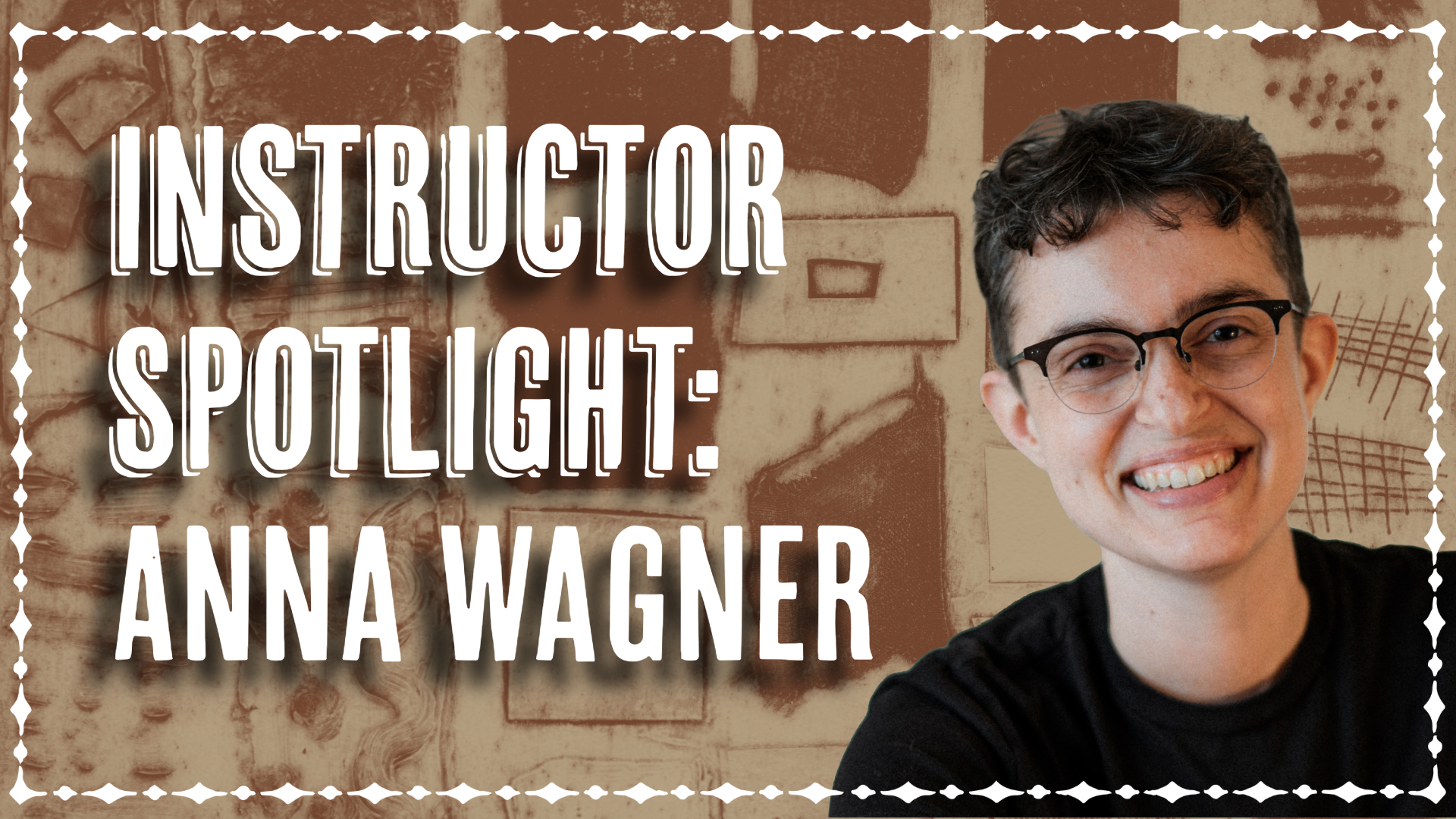
This fall, Wagner brings her expertise to Artists Book House with her workshop Collagraphs: Everyday Materials, Extraordinary Prints. In this hands-on class, she invites students to experiment boldly—transforming common, found objects into compelling works of art. Participants will learn the fundamentals of collagraph printmaking, discover how to “think in print,” and gain a deeper appreciation for the interplay of technique, creativity, and collaboration. Whether you’re a seasoned printmaker or a complete beginner, Anna Wagner’s workshop promises an immersive journey into the tactile, expressive world of printmaking—where curiosity and experimentation are the keys to extraordinary results.
About Anna Wagner
Anna Wagner is an American/Brazilian artist and educator based in Chicago, IL. A dedicated craftsperson, Anna is invested in working with antiquated techniques to explore how marginalized histories resurface throughout time, ever-present and existing in the contemporary world as informed by the past. Wagner was a 2024 recipient of the Artists Run Chicago Fund and the 2025-2026 Artist-in-Residence in Printmaking at Lillstreet Art Center. She has taught widely, including at Penland School of Craft, Oberlin College, and at Duke University. Her work is held in various collections, including Minia University in Cairo, Egypt, the Kennedy Museum of Art, and the College of William & Mary. She is represented by Hoofprint Gallery.
Where can readers find examples of your work?
annawagner.com @annawagnerart (on instagram) I illustrate for the Chicago Reader a few times a year, and covered the DNC
What can prospective students expect to learn in your workshop?
I encourage experimentation in my classes, and collagraph is a truly open-ended medium. Students will learn the basic parameters of what is and isn’t safe to run through a press, but beyond that, anything you find that might make an interesting print is welcome! Bring in materials you have around the house, studio, or wherever you find inspiration.
Printmaking inherently lends itself to collaboration and experimentation because it involves so many steps and possibilities. In my experience, it’s through shared experiments, discoveries, and problem-solving that we can all learn the most. Come ready to experiment, play, and see what we can create together!
If a student were to walk away with one or two key lessons, skills, or principles from your workshop, what would you hope that would be?
I would like my students to develop the ability to “think in print”—to imagine how they might translate their ideas into a print media, while also learning to look at prints and deduce how they were made. Printmaking is a medium that too few people have access to, and it is through hands-on practice that we can truly appreciate its range of possibilities. I hope students leave the class with not only a deeper understanding of how prints are made, but also a greater appreciation for the technical and creative choices behind them.
Can you name an example or two of past workshops you’ve taught, and what most excited you about them?
I had the pleasure of teaching a soft-ground etching class at Penland last summer. When I was 19, I took a lithography class at Penland as a work-study student, and that experience solidified my decision to pursue printmaking. Returning twenty years later as an instructor was a thrill.
Many of my students at Penland were college students, and it was a joy to share as much technical knowledge and skill as I could during the two weeks I was there. For too long, many of the technical aspects of printmaking have been guarded as specialized knowledge. It is important to me to demystify these processes and make them accessible, with the hope that future generations will continue to feel curious, empowered, and excited by printmaking.
What are the most important features of your workspace (studio, office, etc.)?
Two years ago, thanks to the Artists Run Chicago fund, I was able to purchase my own press. Having a press in my apartment has been a game changer! If you're thinking about buying a press, take it from me: do it! you won't regret it!
What are some of your favorite tools in your studio?
I bought a Lyra water-soluble graphite pencil last year and it's been a game changer! It's great to be able to combine soft washes with subtle stumping and shading. It's a lot of fun, would recommend it to anyone.
What inspires and informs your work (other artists, works of art, art forms, aspects of life, etc.)?
It's easy to get inspired in Chicago because there's so much gorgeous craft on display everywhere. A walk through any Chicago cemetery (but especially Rosehill) always gives me ideas. The stained glass, masterful stonework, and chance encounters with deer and coyotes gets me thinking about human history and natural history shaping each other, which is at the core of much of my work.
How did you first become associated with ABH?
I started coming to ABH events a few years ago and am thrilled to be returning now as an instructor
What interests and excites you most about working with ABH?
I am inspired by ABH's commitment to paper-based craft. Chicago certainly needs more of that! I am excited to be part of helping make printmaking more accessible by offering classes at ABH
Other than your ABH workshop, can you name a few other key events or projects in your near future?
You can catch three of my large framed etchings on display at the 4th Street Print Exhibition at the Chesterton Art Center through November, and at Lillstreet Art Center's Printmaking exhibition through September. I will be tabling at several upcoming events including Renegade Craft Fair downtown Chicago on September 12th, Pretty Good Fest and the Chicago Athletic Association on October 24th.